Biocalorimetry: Q1 Research Publication by Dr. Linh Duong on Sustainable Macromolecules
Q1 Research Breakthrough: Biocalorimetry for Sustainable Macromolecules and Circular Bioeconomy
We are thrilled to celebrate a milestone for the Materials Science & Innovation (MSI) program at the Vietnamese-German University (VGU). Dr. Hieu Linh Duong has co-authored a high-impact international review in the prestigious journal Applied Microbiology and Biotechnology (Q1, Impact Factor = 4.3), in partnership with the renowned Helmholtz Centre for Environmental Research (UFZ) in Leipzig, Germany.
The publication, titled "Biocalorimetry for the biotechnological use of natural and synthetic macromolecules" (2026), explores how measuring the metabolic heat of microorganisms in real-time can revolutionize the way we recycle plastic waste and process solid substrates.
The Core Innovation: What is Biocalorimetry?
Biocalorimetry is the real-time measurement of the microscopic amounts of heat released by living microbes as they consume and break down materials. Because all living processes generate heat, this acts as a universal, non-invasive sensor of microbial activity.
This research highlights how biocalorimetry serves as a game-changing tool for solid substrates—ranging from agricultural plant biomass to synthetic plastic polymers—which are notoriously difficult to monitor with traditional liquid sensors.
Key Research Pillars & Student Takeaways
For students in our Materials Science program, this publication represents exactly the kind of interdisciplinary, real-world science they engage in at VGU. The review outlines three major breakthroughs:
1. Multi-Scale Tracking (From Nanoliters to Industrial Bio-Reactors)
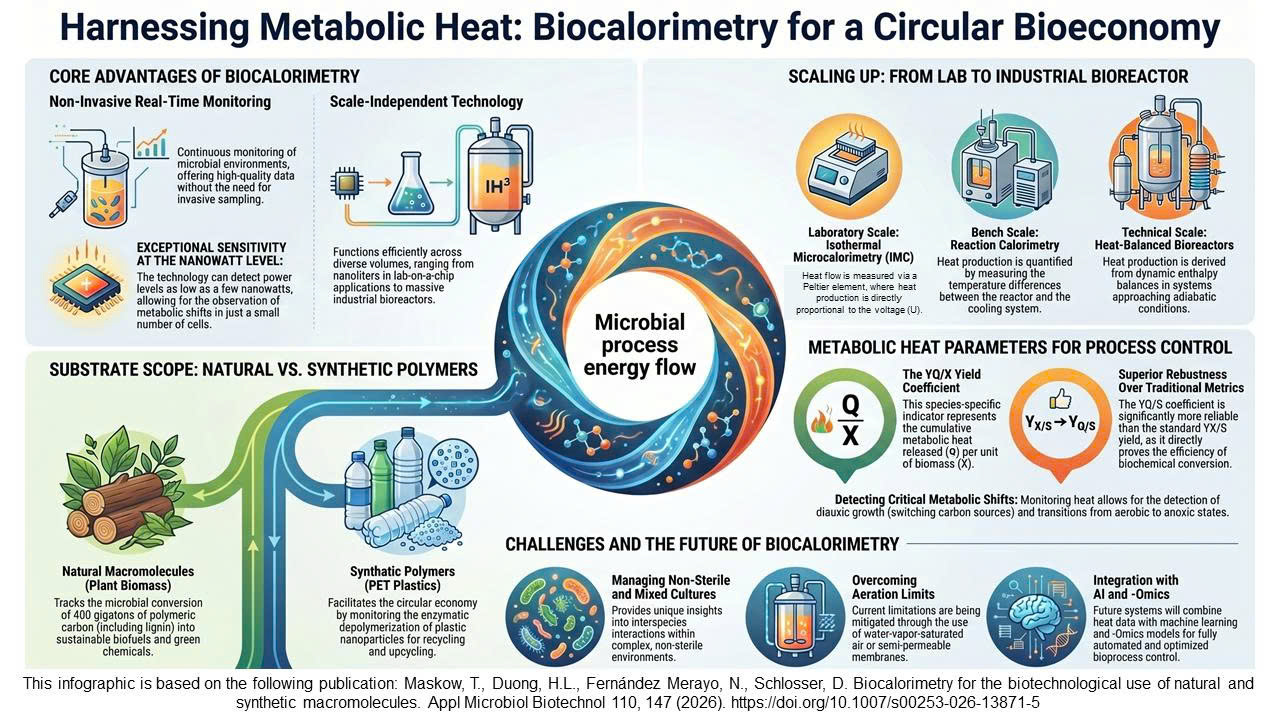
The review provides a critical roadmap of thermodynamic tools capable of tracking microbial activity across massive scale gaps—from tiny nanoliter chip calorimeters used in high-throughput screening to giant 100 m³ industrial bioreactors used in global manufacturing.
2. Upcycling Solid Wastes & Plastic Enzymatic Recycling
Unlike conventional fermentation in liquid liquids, this work focuses heavily on solid substrates. It demonstrates how metabolic heat tracking optimizes the enzymatic recycling of plastics (like PET) and composting, paving the way for next-generation circular bioeconomy solutions.
3. Merging Thermodynamics with Artificial Intelligence (AI)
The authors present a visionary perspective: by combining biocalorimetric metabolic heat data with advanced -omics technologies and machine learning, researchers can build highly predictive AI models to design self-optimizing sustainable bioprocesses.
!NOTEWhy this matters for MSI Students: This publication showcases VGU's rising research footprint and directly connects to our curriculum in polymer chemistry, advanced characterization, and sustainability engineering. Our students work alongside active researchers like Dr. Linh Duong to solve actual environmental challenges.
Institutional Support & Collaboration
This international breakthrough was made possible through extensive collaborative funding and networks:
- Helmholtz Association (Integration Platform at UFZ)
- Helmholtz Investment and Networking Fund (Circular Economy projects: FINEST – KA2-HSC-10 and PUreValue – KA-HSC-13)
- German Research Foundation (DFG) (Projects: TherMic, DriverPool, and EnergyStructures)
- Open Access facilitated by Projekt DEAL
This joint effort highlights the strong, direct ties between VGU and leading German scientific research institutions, giving our students unique pathways to international research careers.
Access the Full Research
Explore the full details of this pioneering work: 🔗 Full Article (Open Access): https://doi.org/10.1007/s00253-026-13871-5